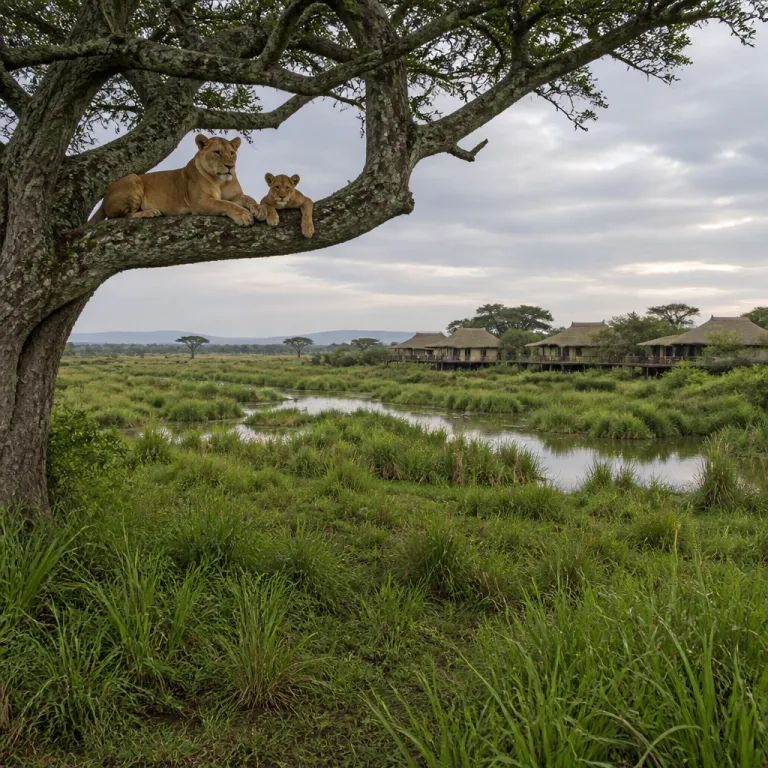
Ishasha’s tree-climbing lions and a slower safari for couples
The southern plains where lions climb trees and couples slow down
The southern plains of the Ishasha sector feel different the moment your vehicle leaves the busier Kazinga Channel area and rolls toward the border with the Democratic Republic of Congo. Here the grasslands open wide, the fig tree crowns sit low and broad, and the famous Ishasha tree-climbing lions turn the mid-morning heat into an art form by draping themselves across horizontal branches. For couples used to crowded game drives in other parts of Uganda, this quieter corner of Queen Elizabeth National Park offers a slower rhythm, fewer vehicles and a more intimate wildlife experience that rewards those who give it at least two full safari days.
Geographically, Ishasha is the southern sector of Queen Elizabeth National Park, a protected area that stretches from the Kazinga Channel in the north down to the Ishasha River in the south. The Ishasha sector borders Congo, and that frontier riverine forest helps explain why lions in Ishasha climb trees so habitually compared with lions in other parts of Uganda. The mix of open savannah, scattered fig trees and cooling riverine woodland creates a natural amphitheatre where animals and visitors share the same broad stage, yet the density of vehicles remains low even in peak safari months. A typical game-drive loop here might cover 20–40 km of tracks in a morning without encountering more than a handful of other safari vehicles.
For a couple planning a luxury stay, the key is to treat Ishasha not as a transit stop between the northern sector and Bwindi, but as a destination in its own right. When you give these plains two nights rather than one, you unlock both the soft dawn light when lions climb into trees after a night of hunting and the golden dusk when elephants, Uganda kob and topi drift toward the Ishasha River. That extra night also builds in time for a slower midday game drive or a quiet pause on your lodge deck, watching birds move between trees while you plan future gorilla trekking days in the highlands. Many couples find that this unhurried pace is what turns a standard safari into a genuinely romantic retreat.
Why Ishasha’s lions climb trees and how to time your sightings
The phenomenon of Ishasha tree-climbing lions has been studied and debated by guides, researchers and visitors for decades, yet the most convincing explanations remain practical rather than mystical. On these open plains of southern Queen Elizabeth National Park, the midday heat can be intense, and the broad fig trees offer both shade and a vantage point from which lions can scan for animals moving across the grasslands. When lions in Ishasha climb trees, they also escape biting insects on the ground, turning the tree branches into elevated day beds where they can rest between hunts. Observations shared by the Uganda Wildlife Authority and field guides echo this view, highlighting heat avoidance, vantage points and insect relief as the main drivers of this behaviour, with some field notes suggesting that prides may spend several consecutive dry-season days using the same favoured fig trees.
From a couple’s perspective, understanding this behaviour shapes how you plan your game drives and how you choose your lodge. The best sightings of climbing lions usually happen from late morning to mid-afternoon, when the sun pushes the pride up into the trees and the light still holds enough softness for photography. That means a well-timed late morning game drive from a lodge close to the core Ishasha sector can be more rewarding than a rushed dawn dash from the northern Kazinga Channel area, where lion sightings tend to be more traditional ground-based encounters. Photographers often aim to be near the classic fig trees between about 10:00 and 15:00, when the combination of shade and height is most attractive to the cats.
Seasonality also matters, because the position of the animals shifts with the rains and the movement of Uganda wildlife across the park. During drier periods, typically from June to August and again from late December to February, more animals concentrate near the Ishasha River, and Ishasha lion prides often choose trees close to that corridor, while in greener months they may spread out across the southern plains. For couples combining gorilla trekking with a stay here, it is worth asking your lodge to coordinate your Uganda itinerary so that your gorilla trekking day in Bwindi does not follow immediately after a very long game drive day in Ishasha, preserving your energy for both experiences and keeping the romance intact.
Lodges that place you at sunrise: where to stay for front row branches
Accommodation in the Ishasha sector is limited compared with the busier northern reaches of Queen Elizabeth National Park, and that scarcity is part of the appeal for couples seeking privacy. A handful of intimate lodges sit either inside the park or just beyond its boundaries, placing you within a short game drive of the main fig trees where tree-climbing behaviour is most often observed. When you choose a lodge that fronts the Ishasha River or overlooks the open plains, you shorten the time between your morning coffee and your first sight of lions that climb trees to escape the heat. Typical transfer times from these lodges to the core viewing areas are often 10–30 minutes, which makes it easy to return for a relaxed brunch after a sunrise drive.
Properties such as Ishasha Wilderness Camp and Enjojo Lodge offer different interpretations of luxury, from classic canvas tents with polished service to more rustic-chic cottages set among trees and wetlands. Typical nightly rates for quality lodges in this area often range from about US$250–US$450 per person sharing for mid-range stays to roughly US$500–US$900 per person sharing at the top end, reflecting the small scale and remote setting, and most properties provide direct contact pages or reservation teams to help couples tailor their stay. What unites the best lodges here is a focus on guiding quality, because a knowledgeable guide who understands the daily movements of animals in the Ishasha sector will know which tree branches to check first on any given game drive. For couples who value wellness as much as wildlife, it is worth pairing a stay here with a property that offers serious spa and recovery programs after long safari days, such as those highlighted in this guide to wellness programming that earns its place on a Uganda itinerary.
Because visitor numbers remain lower than around the Kazinga Channel, you are more likely to have a tree-climbing lion sighting to yourself or shared with just one other vehicle. That solitude changes the emotional texture of the experience, turning a simple game drive into something closer to a private audience with the plains. When you return to your lodge after a long game drive, sundowners on the deck feel earned, and the sounds of Queen Elizabeth National Park at night remind you that this is still a wild frontier where animals, trees and riverine forest dictate the schedule rather than human timetables. If you are planning to use images from your stay, think about framing photographs that would suit descriptive alt text such as “Ishasha tree-climbing lions resting on a fig tree branch at midday” or “sunset over the Ishasha River in southern Queen Elizabeth National Park.”
Designing your Ishasha game drives and comparing sectors for couples
Planning your Ishasha game drives with intention is the difference between ticking a box and feeling that you have truly understood this southern sector. For couples, the most effective pattern is usually a shorter dawn game drive focused on general wildlife, followed by a longer late morning or early afternoon loop that targets the key fig trees where tree-climbing lions often rest. Leaving your lodge just after first light allows you to watch elephants, Uganda kob and topi moving through the mist while the lions finish their night’s work on the ground.
After a relaxed breakfast back at the lodge, a second game drive that begins mid-morning positions you perfectly for the hours when lions climb trees to escape the rising heat. Guides who know the Ishasha sector well will often start by checking the classic fig trees near the main tracks, then fan out toward the Ishasha River if the branches are empty. This is where the contrast with the northern Kazinga Channel area becomes clear, because in the busier northern region of Queen Elizabeth National Park, game drives can feel more structured and less exploratory due to higher vehicle numbers and more fixed routes. Couples who prefer a sense of discovery often comment that Ishasha’s quieter tracks feel more like a private concession than a mainstream safari circuit.
For couples deciding how to split their safari days between the two sectors, the choice comes down to atmosphere and priorities. The northern area around the Kazinga Channel excels for boat-based wildlife viewing, dense concentrations of hippos and birds, and a wider range of lodges, while Ishasha offers fewer visitors, more open plains and the unique spectacle of Ishasha lion prides that climb trees as part of their daily routine. If your wider Uganda wildlife itinerary also includes highland retreats such as those around Lake Bunyonyi, you can weave Ishasha into a broader circuit of refined nature stays, using resources like this guide to refined nature retreats on Uganda’s highland waters to balance plains, lakes and forest.
Linking Ishasha with Bwindi and structuring a two night stay
The road between Ishasha and Bwindi Impenetrable National Park is one of the most rewarding transfers in Uganda for couples who enjoy watching the landscape change. Leaving the open grasslands of the Ishasha sector, you climb gradually into the highlands where tea plantations, villages and forested ridges signal your approach to gorilla country. Many visitors treat Ishasha as a simple stopover on the way to gorilla trekking, but building in two nights here before or after your gorilla trekking days in Bwindi creates a more balanced and less rushed itinerary.
From a practical standpoint, the drive between Ishasha and the main Bwindi trailheads usually takes around three to four hours in typical dry-season conditions, depending on road quality and whether you stop for viewpoints or markets. Distances vary by sector, but many couples cover roughly 80–120 km on this transfer, with the final approach to Bwindi often on graded gravel or dirt roads that can slow progress in the rains. That means a morning departure from your Ishasha lodge after a final short game drive can have you in Bwindi by mid-afternoon, with enough time to settle into your forest lodge and prepare for the physical demands of gorilla trekking. Couples often find that the gentle game viewing of Ishasha, where you watch animals from the comfort of a vehicle and admire lions that climb trees from a respectful distance, provides a welcome contrast to the more strenuous trekking required to reach gorilla families in the national park.
When planning your days Uganda wide, it helps to think of Ishasha and Bwindi as complementary chapters in a single narrative rather than separate trips. The plains teach you to read the language of grass, trees and open sky, while the forest teaches you to listen for rustles and distant calls as you follow trackers on steep slopes. For a broader perspective on how Ishasha fits into a refined safari circuit that might also include the Kazinga Channel, Kibale’s chimpanzees or the crater lakes, consult this curated overview of what to see for a refined safari stay in Africa, then work with your lodge or operator to align game drives, trekking permits and transfer times.
Why Ishasha deserves two nights: dawn, dusk and the luxury of space
Spending two nights in Ishasha rather than one transforms the sector from a checklist stop into a place you actually inhabit. On the first afternoon, you may be focused on the headline act of Ishasha tree-climbing lions, scanning every fig tree for a tail or a paw draped over the branches. By the second dawn, your attention often widens to include the way light moves across the plains, the silhouettes of trees against the sky and the quieter animals that share this corner of Queen Elizabeth National Park.
From a wildlife perspective, two nights double your chances of seeing climbing lions in different moods and positions, because lion prides in this part of Uganda do not always use the same trees on consecutive days. One game drive might reveal a single male stretched along a branch like a dropped rope, while another might show an entire pride of Ishasha lions packed into the crown of a single tree, their tails flicking in unison. That variety, combined with the lower visitor density compared with the Kazinga Channel area, gives couples space to linger at sightings without feeling rushed, turning each game drive into a more contemplative experience.
There is also a psychological luxury in knowing you do not have to leave immediately after your first successful sighting of lions that climb trees. With an extra night, you can return to the same tree branches at different times of day, watch how the animals shift positions as the sun moves and notice how other species interact with the trees once the lions descend. Over the course of those safari days, Ishasha stops being just a sector on a map and becomes a place whose rhythms you understand, a southern plain where the combination of trees, animals and open sky creates a uniquely Ugandan form of romance for couples who take the time to stay.
FAQ
How many nights should a couple spend in the Ishasha sector ?
For most couples, two nights in the Ishasha sector of Queen Elizabeth National Park strike the right balance between focused lion viewing and relaxed lodge time. One night can feel rushed, especially if you are arriving from the Kazinga Channel area or heading on to Bwindi for gorilla trekking. With two nights, you can enjoy at least three unhurried game drives, increasing your chances of seeing lions that climb trees in different light and weather conditions.
When is the best time of day to see tree climbing lions in Ishasha ?
Tree-climbing lions in Ishasha are most often seen in the late morning to mid-afternoon, when the heat encourages them to rest on the branches of fig trees. Early morning game drives are still valuable for general wildlife viewing, but lions are more likely to be on the ground finishing their night’s activities. Planning a second, later game drive specifically targeting known fig trees gives you the best chance of seeing lions in the trees.
How does Ishasha compare with the Kazinga Channel area for couples ?
The Kazinga Channel area in the northern part of Queen Elizabeth National Park offers dense concentrations of hippos, birds and other wildlife, especially from boat cruises, and it has a wider range of lodges. Ishasha, by contrast, has fewer visitors, more open plains and the unique spectacle of lions that habitually climb trees. Couples who value privacy and slower, more exploratory game drives often prefer to include both sectors in their itinerary, using Kazinga for water-based wildlife and Ishasha for the iconic tree-climbing lions.
Can Ishasha be combined easily with gorilla trekking in Bwindi ?
Yes, Ishasha links very naturally with Bwindi Impenetrable National Park, and many itineraries combine the two. The drive between the Ishasha sector and the main Bwindi trailheads usually takes several hours, so it is practical to enjoy a final short game drive in Ishasha in the morning and arrive at your Bwindi lodge by mid-afternoon. This sequence allows you to experience plains wildlife and tree-climbing lions before or after the more physically demanding gorilla trekking days.
Is Ishasha safe given its proximity to the Congo border ?
The Ishasha sector borders the Democratic Republic of Congo, but tourist activities take place within the Ugandan side of Queen Elizabeth National Park under the management of the Uganda Wildlife Authority. Lodges and operators monitor security conditions closely and adjust routes if necessary, and park rangers maintain a visible presence on key tracks. As with any safari destination, traveling with reputable operators and following guide instructions is the best way to ensure a safe and enjoyable stay.